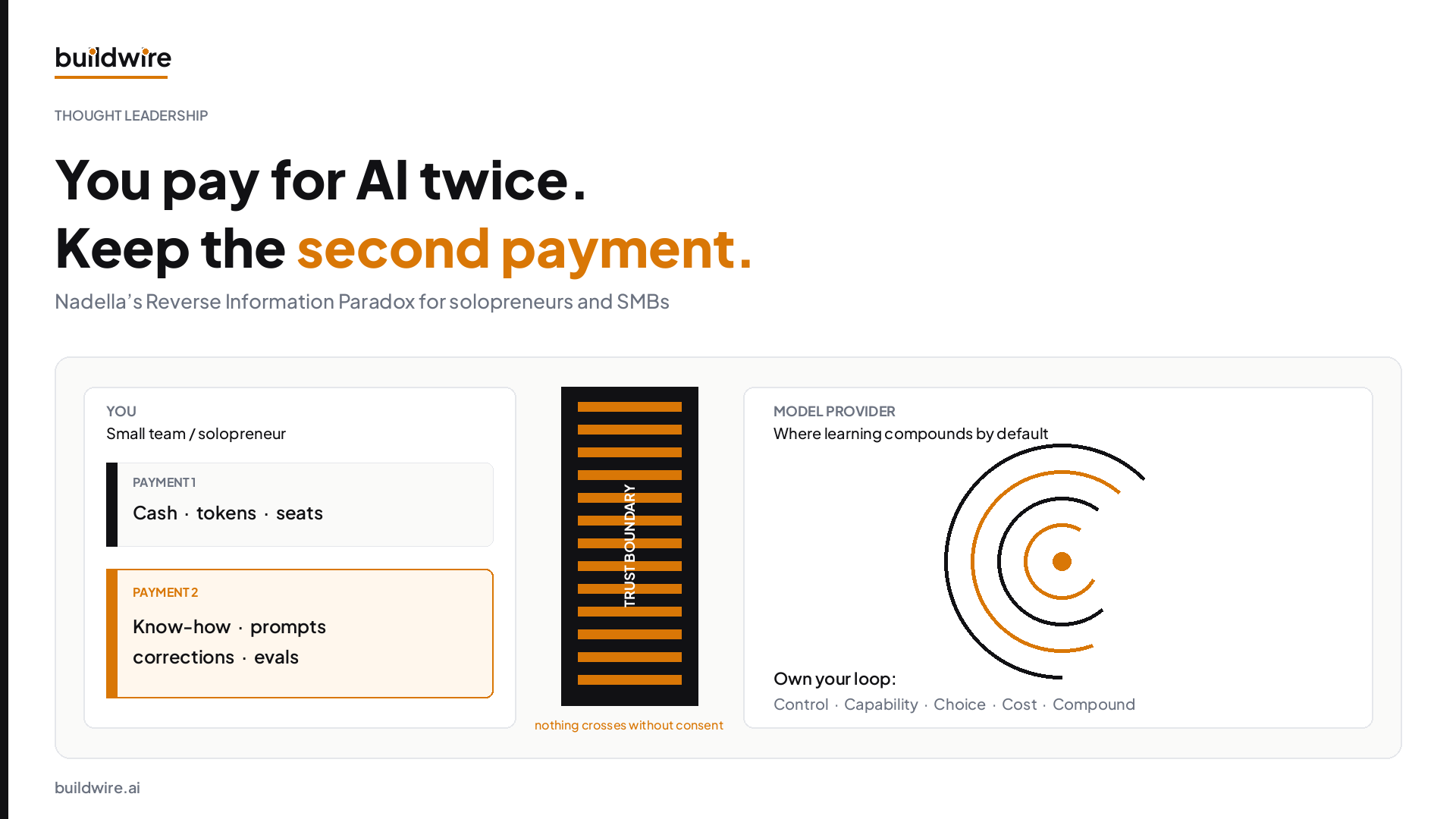
Something I’ve been noticing while working with AI every day: the more useful the model gets for my work, the more of my work I have to put into it.
Not only files. Pricing logic. The correction that turns a weak draft into something I would send. Client details I paste so the answer is usable. That know-how is what makes a small business feel like a business.
Last weekend, Microsoft CEO Satya Nadella named that dynamic the Reverse Information Paradox. Most coverage stayed enterprise. This is the operator version for solopreneurs and small teams: what it means, and what you can do in about 30 minutes without an IT department.
What is the Reverse Information Paradox?
Economist Kenneth Arrow described a classic problem: a seller often has to reveal an idea to prove its value, and once revealed, the buyer already has it. Nadella argues AI flips the risk.
In the AI age, the buyer is exposed. To make a model useful, you feed it proprietary knowledge. The better you want it to perform, the more you feed it. You pay twice:
- With money (subscriptions, tokens, seats)
- With know-how a competitor cannot easily buy
That second payment is the one most small teams never name.
Nadella’s sharper point is intelligence exhaust. Not only “your data,” but:
- the prompts you write
- the tools your agents call
- the corrections you make when the model is wrong
- the evals that define what “good” looks like inside your work
Every fix is institutional know-how, distilled. It can leak slowly: trace by trace, correction by correction, eval by eval. The seller can learn more about how you operate. You learn little in return.
His line that stuck with me: in consuming intelligence, you are creating intelligence, and what you create should belong to you.
Primary: The Reverse Information Paradox (12 July 2026). Also: TechCrunch, The Register.
Why small teams feel this harder than big companies
Large companies have lawyers, tenant boundaries, and procurement checklists. Most solopreneurs and SMBs do not.
We often run client work on personal Plus or Pro plans. Training defaults vary by product. Sensitive context sits in chat history because that is the fastest path to a good answer. When agents enter the picture (folders, Drive, email, multi-step jobs), exhaust expands. You are no longer pasting one paragraph. You are letting a system touch workflows.
If your “company memory” lives only inside one vendor’s chat product, and you never export the corrections that made it good, you rent the loop. You do not own it.
One calm note on the messenger: Nadella’s fix maps cleanly to cloud products Microsoft sells. Trust the diagnosis. Discount the product placement. Use the framework without buying that stack.
How can a small business protect IP when using ChatGPT or Claude?
Nadella’s playbook is five C’s: Control, Capability, Choice, Cost, and Compound. Same structure, rewritten for a 1-20 person team on ChatGPT, Claude, Gemini, and a pile of docs.
Control: own what “good” looks like
Nadella intent: private evals; ownership of memory, traces, feedback, and decisions.
For a small team: you will not build a formal eval platform. You can still write down what good looks like.
This week: open a private note you own. Add 5-10 “good” and “bad” examples for one workflow (proposals, content, outreach, reporting). Score them in plain language. Check data controls on personal plans. For client work, prefer settings that keep training off by default.
Capability: private context without giving the whole company away
Nadella intent: learning environments inside a tenant boundary, without shipping company knowledge outward.
For a small team: capability usually means context packages you control: brand voice, ICP, offer sheet, past winning proposals, SOPs. Keep them in a folder you own. Inject per task instead of pasting the whole business into every chat.
This week: create one “context pack” folder for your highest-value workflow. Minimum necessary context only. Keep secrets and client dumps out of folders a coding agent might open. Settings toggles are not a full trust boundary.
Choice: do not marry one model
Nadella intent: decouple orchestration from any single model so capability survives vendor changes.
For a small team: a short routing guide you own: which tool for writing, research, code or agents, and what “done” means.
This week: one page, three tools max. Reuse the same eval note across tools. If one model disappears tomorrow, your definition of good should still travel.
Cost: match the task to the model, not your habit
Nadella intent: combine context, models, and tasks efficiently without giving up quality.
For a small team: cost is sticker price plus paying frontier rates for work a cheaper tier could finish, plus rebuild cost after lock-in.
This week: pick one recurring job. Run cheap/fast vs strong. Keep the cheaper path if quality holds against your eval note. Track cost per run, not only the plan name.
Compound: turn corrections into a playbook you own
Nadella intent: a continuous learning loop that compounds for the firm, not only the model provider.
For a small team: the habit most people skip. You correct the model, then leave the learning inside a thread you never open again.
This week: 15-minute Friday review. Save the prompt that worked, the correction that fixed a miss, and the final accepted output. Over months, that playbook is harder to copy than a subscription.
| C | SMB translation | One action this week |
|---|---|---|
| Control | Private definition of “good” | 5-10 scored examples for one workflow |
| Capability | Context packs you own | One folder, minimum necessary context |
| Choice | Model-agnostic process | One-page routing guide (3 tools max) |
| Cost | Task-to-model fit | A/B one job on cheap vs strong tier |
| Compound | Corrections become assets | 15-minute Friday playbook update |
A 30-minute checklist
- List every AI account you use for work (personal vs business) and check training / data-sharing settings.
- Create a private eval note with 5-10 good vs bad outputs for your main workflow.
- Move client-sensitive context out of random chats into a controlled folder.
- Write a one-page model routing guide (three tools maximum).
- Copy this week’s best prompts and corrections into a living playbook you own.
- Before installing any coding agent: point it only at a limited project folder; keep
.env, keys, and client dumps out. - Decide what never goes into a prompt (pricing floors, unreleased offers, private client data).
- Put a 15-minute Friday review on the calendar so the loop compounds.
You do not need all eight perfect on day one. Control + Compound alone already change how much of your edge stays with you.
What most coverage misses
Most reaction treated the essay as a privacy scare or a cloud sales note. The useful reading is narrower.
The Reverse Information Paradox is not “stop using AI.” It is about who owns the learning that appears when you use AI well. Models will keep improving for everyone. Your corrections, routing rules, and private evals will not, unless you keep them.
For small teams, the edge is less “best model this month” and more “a learning loop that still works when model names change.”
Closing
Nadella’s ask is simple to state and hard to live: use a model without giving up the knowledge that makes you unique.
For a small team, that does not require a new platform by Friday. It requires a private definition of good, a context pack you control, a routing guide that survives vendor churn, honest cost matching, and a habit of saving corrections.
I’m still tightening my own loop. If you try the checklist, notice which of the five C’s you already do by accident, and which one has been leaking without a name.
Sources
Primary
- Satya Nadella, “The Reverse Information Paradox,” sn scratchpad, 12 July 2026: https://snscratchpad.com/posts/reverse-information-paradox/
Secondary reporting
- Julie Bort, TechCrunch, 13 July 2026: https://techcrunch.com/2026/07/13/satya-nadella-has-issued-a-shocking-warning-to-companies-using-ai/
- Brandon Vigliarolo, The Register, 13 July 2026: https://www.theregister.com/ai-and-ml/2026/07/13/microsoft-chief-turns-hostile-on-frontier-ai-labs-warns-companies-to-guard-their-ip/5270628
Related context (coding-agent data boundaries)
- Hacker News discussion of Grok Build CLI upload analysis: https://news.ycombinator.com/item?id=48877371