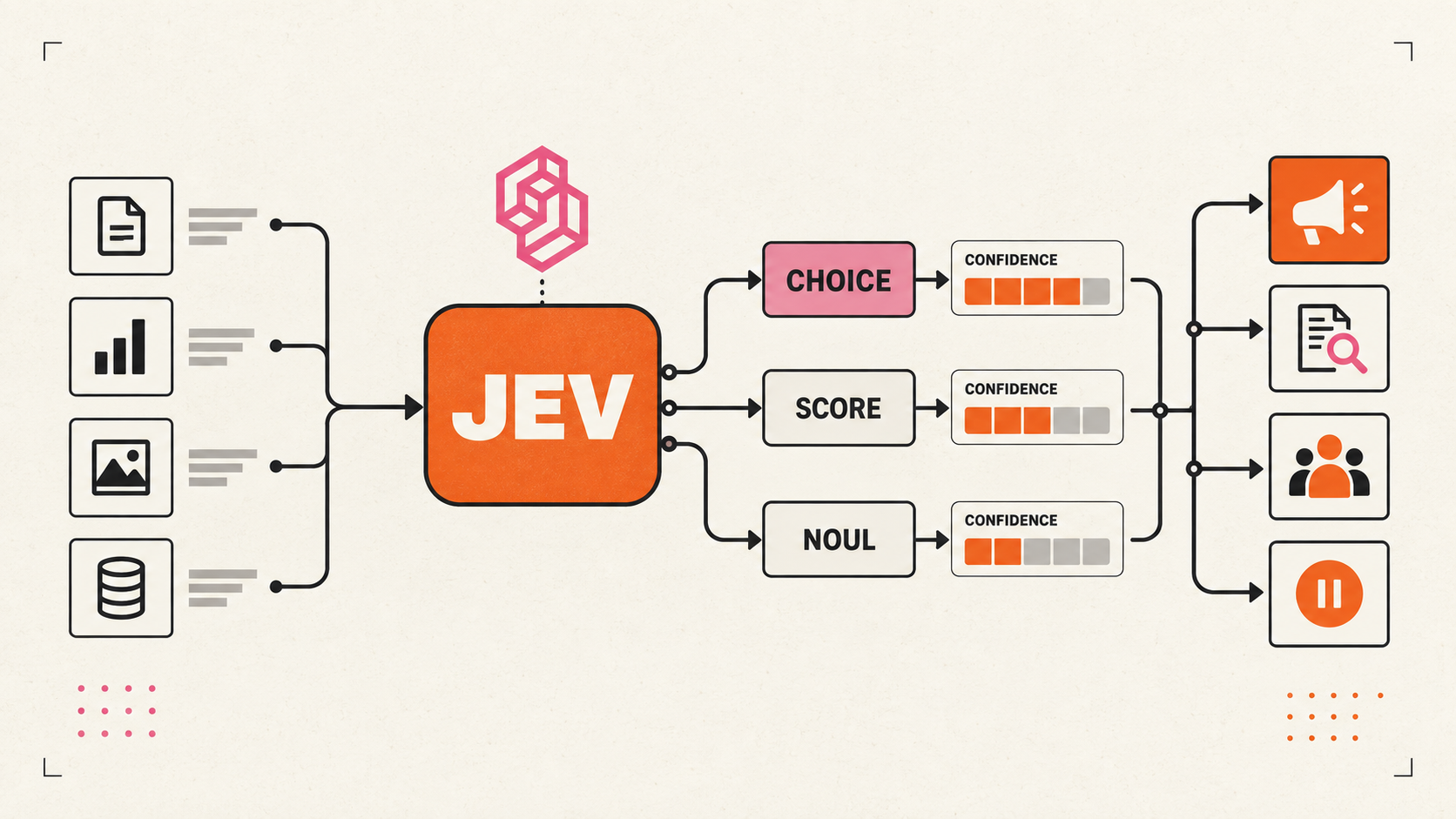
Marketers keep asking AI to write more. The bottleneck is usually deciding what deserves a draft, a bit of spend, or a call.
TypeSafe AI’s JEV is built for that second job. It is a System One model: you hand it a state (facts your code already knows) plus typed questions - Choice, Score, or Noul (yes/no probability) - and you get structured answers with confidence your software can branch on. It does not crawl your site, invent URLs, or generate free-form copy.
Eric Siu put the marketing framing cleanly: generating more ideas is easy; choosing which ones deserve a draft is harder (post).
BuildWire’s take for lean GTM teams: JEV is the referee. Your LLM (or your writer) is still the author. Low confidence → human. High confidence → auto-route. Keep a review gate whenever money or brand is on the line.
The core loop
- Collect facts with ordinary software (exports, crawler, form payload, ad creative text via OCR if needed).
- Ask typed questions - Choice (one of N), Score (rubric), Noul (P(true)).
- Branch on answer + confidence - e.g. score ≥ threshold and confidence ≥ 0.7 → queue; else → human review.
- Only then draft, spend, or publish with a separate writer (human or generative model).
If you ask JEV to “write the landing page,” you are using the wrong tool.
Cost and tokens: what TypeSafe currently claims
TypeSafe’s public site (typesafe.ai) frames JEV as decisions, not strings: typed outputs software can act on, plus calibrated confidence on every decision. That matters for marketing ops because the expensive step is usually the generative call - the draft, the rewrite, the long agent loop. JEV’s job is to clear or kill the work before those tokens burn.
Thesis for this post: JEV saves spend by skipping generative tokens until a Choice, Score, or Noul clears the gate. High-confidence “no” stays cheap. High-confidence “yes” still pays for writing once. Low confidence still goes to a human - that is the approval culture, not a bug.
Current claims on TypeSafe AI and its JEV launch note:
- Speed / cost proof (System One workflows): ~193.6× faster and ~444.6× cheaper vs LLM workflows for System One tasks - TypeSafe’s workflow evaluation, not an independent BuildWire benchmark. TypeSafe says these gains are at the higher end of what teams should expect.
- Input price framing: $42 per billion input tokens on the same site.
- Vs Claude Fable 5.1 (vendor page): ~238× lower input price than Claude Fable 5.1 - again TypeSafe’s comparison, not ours.
Community anecdote - not an SLA: one published community run described scoring on the order of ~724 ads × many questions in ~40 seconds for about $0.09. That is a demo story from the public use-cases surface, not a TypeSafe service-level promise. Your latency and bill will depend on state size, question count, and the price you are actually billed at call time.
Five try-it marketing use cases
These five are for readers who arrive from LinkedIn and want something concrete to run this week. Each one is a full loop: facts in → typed questions → branch → only then write or spend.
1) Score topic ideas before anyone drafts
State: ICP notes, product one-liner, competing angles, search/social demand hints.
Ask (examples):
- Score ICP fit (0–5)
- Score differentiation vs your last three posts
- Score demand evidence (thin / medium / strong)
- Score hook strength
- Noul: is this off-brand or bait?
Branch: only ideas that clear your floors get a draft brief. Everything else stays in the backlog or dies quietly. This is the fastest no-crawl win for a content team.
2) Tag the content library
An independent JEV examples site shows a content-dashboard pattern built around Choice and Score questions for topic, hook, format, and style - the same judgment involved in annotating a large post library (use cases).
Marketers use that to:
- find gaps (lots of tips posts, no comparison pages)
- reuse winners instead of rewriting the same angle
- keep CMS taxonomy honest
You still write and edit outside JEV. JEV only labels and ranks what you already published or queued.
3) Pre-publish draft scores
Before something goes live, score the draft - not to rewrite it inside JEV, but to flag:
- AI-slop / generic filler (Noul or Score)
- clickbait / overclaim (Noul)
- off-brand voice (Score vs brand rubric)
- ICP relevance
Low confidence or failing floors → editor. Passing floors → schedule. Generative rewrite tokens only fire when a human (or a separate writer model) decides the draft needs work.
4) Lead and inbox triage
Lead triage is a natural fit for JEV’s typed decision API: classify, prioritize, route from raw text in one call. Practical GTM shape:
- Choice: route (sales / support / partnerships / spam / other)
- Score: intent strength
- Noul: worth a same-day call?
- Confidence below threshold → human inbox
That is the BuildWire measurement-desk instinct applied to inbound: read facts → propose a route → human when unsure. You are not asking a chat model to “handle the lead” in prose before you know where it belongs.
5) Paid ads: teardown, LP match, and spend gates
An independent JEV examples site’s ad-teardown demo breaks a live ad into hook, offer, CTA, and awareness stage - the tagging pattern behind teardown of 724 ads across 37 brands (use cases).
Ask (examples):
- Choice: primary hook type (problem / proof / offer / curiosity / other)
- Choice: awareness stage (unaware → most aware)
- Score: offer clarity
- Score: CTA clarity
- Noul: ad and landing page promise match?
- Noul: brand-safety risk before spend?
- Score: creative rank vs the rest of this week’s set
- Choice: comment class (question / praise / complaint / spam) for social moderation
Gate before spend: high-confidence “mismatch” or “unsafe” → do not enable the ad. Medium → media lead review. Clear pass → creative can enter the test queue. JEV still does not upload the creative; your ads tooling does.
Again: the ~724 ads / ~$0.09 story is a community demo anecdote, not an SLA.
Bonus: SEO internal links and triage
Internal linking is another practical JEV example: decide whether one page should honestly link to another. Writeups (e.g. Screpy’s JEV internal-linking guide) stress the split:
- Crawler / code builds an eligible target set (200s, canonical, indexable, not already linked, not thin).
- JEV Choice picks the best target for a passage - or
no_link. - Editor approves low-confidence or money pages; anchor text is written outside JEV.
JEV does not crawl, invent URLs, or write anchors.
Other SEO gates that fit
- Relevance filter before rewrite: Noul/Score - is this URL worth refreshing for this query, or is it the wrong page?
- Keyword / brief triage: Choice for intent; Noul for cannibalization risk vs an existing URL; Score for ICP fit before anyone briefs a writer.
Same rule: software proves crawl facts; JEV judges the ambiguous shortlist; humans own strategy and publish.
Five more try-it designs (BuildWire applications - not TypeSafe playbooks)
These five are BuildWire application designs for marketers who already saw the LinkedIn trio (blog Choice, ad/LP Noul, SEO internal-link Choice) and want more gates. They are not TypeSafe-documented playbooks. Treat them as try-it patterns: decide first, then draft, spend, or book time. No outcome stats claimed - measure on your own queues.
Thread for all five: each is a gate / filter / routing call before human time or money.
A) Comment moderation routing (Noul)
State: comment text, post or ad context, optional commenter history flags your CRM already has.
Ask (examples):
- Noul: is this a sales inquiry (pricing, demo, “how do we buy”)?
- Noul: is this a support/product issue?
- Noul: is this noise (spam, off-topic, abuse)?
Branch: high-confidence sales inquiry → sales queue (or calendar link path). High-confidence support → support. High-confidence noise → auto-hide or ignore list. Confidence below your floor → human moderation. Do not invent reply copy inside JEV; draft replies only after the route is clear.
B) Subject line pick before send (Choice)
State: campaign goal, segment notes (who gets this send), and four subject-line candidates you already wrote.
Ask: Choice - which subject best fits this segment and goal (options = the four candidates, plus optional none_of_these if you want an escape hatch).
Branch: high-confidence winner → primary send. Optional: hold 10% of the list as a test cell on the runner-up or a human pick. Low confidence → human picks before send. JEV does not write the subject; it only chooses among candidates you supplied.
C) Lead reply intent classification (Noul)
State: the lead’s latest reply (and short thread context), plus any CRM fields you already trust (product interest, stage).
Ask: Noul - is this person asking for a call and/or pricing?
Branch (band routing):
- > 0.8 (and confidence clears your floor) → calendar / sales handoff path
- < 0.3 → nurture sequence (no same-day pitch)
- middle band → human reads before any reply drafts burn tokens
Tune the 0.8 / 0.3 bands on labeled replies from your own inbox. Do not treat the numbers above as a proven SLA.
D) Creative fatigue call (Score)
State: last 14 days of creative-level facts your ads platform already exports - frequency, CTR, spend (and optional impressions). One creative per call, or batch if your tooling supports it.
Ask: Score fatigue 1–5 (you define the rubric: e.g. 1 = fresh, 5 = worn out / rotate now).
Branch: read the full score distribution, not only the point estimate. High fatigue + high confidence → pause or rotate before more spend. Mid band → media lead review. Low fatigue → leave in test. JEV does not upload replacements; your ads tooling and creative team do.
E) Next-channel budget shift (Choice)
State: last 90 days of channel facts you already trust - CPA (or CAC proxy) and pipeline contribution for search, social, and email - plus the incremental budget amount you are deciding where to put.
Ask: Choice - where should the next incremental budget dollar go: search / social / email (add hold if you want a do-nothing option).
Branch: only auto-recommend when confidence clears your floor. Otherwise human override owns the shift. This is a routing call before money moves - not a full media plan, and not a claim that JEV improves ROAS by itself.
What not to use it for
| Skip JEV for… | Use instead |
|---|---|
| Writing ads, emails, or SEO pages | Human or generative LLM |
| Strategy essays / narrative brand stories | Human |
| Screenshots with no OCR / extracted text | OCR pipeline, then JEV on text state |
| Long multi-step audits that need tools + prose | Claude Code / Skills loops with exports |
| Discovering every page on the site | Crawler / Search Console / sitemap |
If the output you need is a paragraph, JEV is the wrong model. If the output you need is a branch in code, it is a candidate.
BuildWire-shaped start order
For a lean marketing team (and for buildwire.ai itself), adopt in this order:
- Content idea gate - score topics before drafting. Fastest win; no crawl required.
- Lead / form scoring - route + intent + “call today?” with a hard human floor on low confidence.
- Ad teardown + LP match - only if you buy traffic. Consistency and safety before scale.
- Internal links on buildwire.ai - once a crawl (or CMS export) exists: eligible candidates → Choice → editor on money pages.
Wire confidence thresholds into the same approval culture as the rest of BuildWire’s GTM automation: tools propose; people approve when brand or budget moves.
How to try (without buying a religion)
- Pick one queue (topic backlog or inbound form).
- Write 3–5 typed questions and a confidence floor (start strict, e.g. 0.7).
- Log answer, probabilities, confidence, and human override for two weeks.
- Only then auto-route the high-confidence slice.
- Keep drafting in Claude (Skills / Code) or with your writers - JEV stays the referee.
BuildWire helps marketers automate GTM with approval gates. JEV is one pattern for the decision layer in that stack - not a BuildWire product feature today, and not a replacement for Skills, Claude Code, or n8n. Skills encode the method; Code runs heavy loops; n8n moves data on time; JEV answers the tiny high-volume judgments those systems should not fake with a chatty paragraph.
Honest limits
- Demo volumes, dollar figures, and TypeSafe multipliers on the public web are vendor claims or illustrative demos. Re-measure on your traffic before you budget against them.
- Confidence ≠ truth. Calibrate on labeled examples from your own site and ads.
- Do not put crawl policy or access control into a decision model. That stays in code and
robots.txt.
Sources
- TypeSafe AI (vendor speed, cost, and pricing claims)
- Introducing System One Models and JEV
- TypeSafe API reference
- https://jevtypesafeai.com/use-cases
- https://x.com/ericosiu/status/2101737133165924680
- https://screpy.com/blog/typesafe-jev-internal-linking-opportunities/
Frequently asked questions
What is JEV?
JEV is TypeSafe AI's first System One model. It reads supplied state and answers typed Choice, Score, or Noul questions with probabilities and confidence that software can use for routing and review gates.
Does JEV write marketing copy?
No. JEV returns structured decisions rather than free-form copy. A writer or a generative model still handles ads, emails, landing pages, and articles after the decision gate.
What are Choice, Score, and Noul?
Choice selects from a defined set, Score rates an input on a defined scale, and Noul returns a calibrated probability for a yes-or-no question. Each can be paired with a confidence threshold and a human review path.
Where should a marketing team try JEV first?
A small, labeled queue is a practical starting point. Topic scoring, lead routing, ad and landing-page match checks, or choosing among existing subject lines can be tested before connecting JEV to any automatic action.
Last reviewed 22 September 2026. TypeSafe's launch article, public pricing claims, API reference, and the linked community examples were checked on 22 September 2026. Pricing and early-access performance can change.