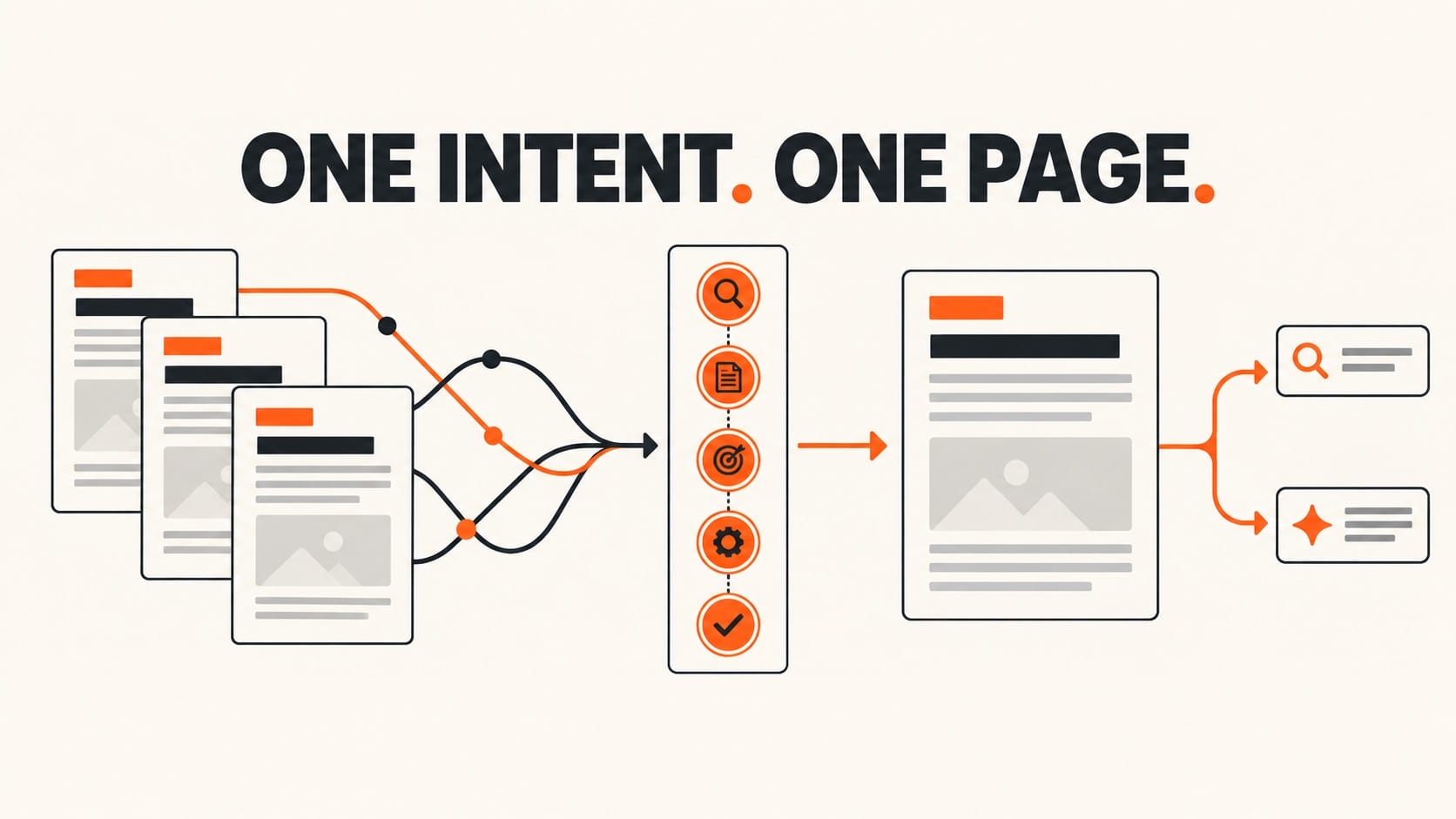
Claude made it cheap to ship another page, and that speed is useful. It is also the quickest way to build competitors on your own domain.
Keyword cannibalization can happen when two or more URLs on the same site answer the same search intent for the same audience. Search engines may treat them as substitutes and choose a different URL from the one you intended. Fast AI publishing raises the risk because each new brief can repeat an intent the site already covers. Use a five-step gate before the next brief: inspect the overlap in Google Search Console, cluster by intent, consolidate or differentiate, brief only for open clusters, and get a human sign-off.
What is keyword cannibalization?
Keyword cannibalization is a site-level SEO problem where two or more pages serve the same search intent for the same reader, with enough overlap that search engines may see them as substitutes. The shared job matters more than the shared keyword. A guide to "B2B email subject lines" and a list of "ecommerce email subject line examples" share a phrase but serve two different readers, so both pages can earn their place. Two posts titled "best AI writing tools 2026" and "top AI writing tools this year" do the same job in different words. Search engines may choose an unintended version, and signals can be divided across the pages. Bing's Webmaster team describes this risk for near-duplicate pages.
Why does fast AI publishing make keyword cannibalization worse?
AI drafting removes the friction that used to slow overlap down. Writing a second post on the same question once took a week, so someone usually noticed the first post along the way. With Claude, a team can run brief, draft, publish, and next brief in an afternoon, and nothing in that loop checks whether the site already owns the question. Each new page reads as fresh while the intent underneath repeats.
Operators on X keep landing on the same diagnosis this month. One SEO automation builder named keyword cannibalization as the biggest problem with SEO automation tools, ahead of the quality of the generated text (@Dmytro_Sokhach, Sep 16, 2026). Another warned that mass-producing 200 AI pages on the same keywords creates self-competition (@miraz_seo17, Sep 19, 2026). Some operators report deleting a large share of their posts and seeing traffic rise afterwards (@Digi_Ingenuity, Sep 2026). These are self-reported notes from small accounts, and they are neither controlled tests nor BuildWire results. They still point at one mechanism: fewer competing URLs give search engines a clearer winner.
On Reddit, the costly version looks like a team that published scaled AI content under management pressure, took a manual action, and then debated deleting the whole blog directory (r/SEO, Sep 2026). A gate before the brief costs far less than that cleanup.
Does keyword cannibalization affect AI Overviews and ChatGPT citations?
It can. Bing's Webmaster team says AI systems may group near-duplicate URLs and select an outdated or unintended version. Google says a page must be indexed and eligible for a snippet to appear as a supporting link in AI Overviews or AI Mode, and that both features may run related searches through "query fan-out" (Google Search Central). These sources describe a selection risk, not a guarantee that combining pages will earn a citation. The stakes for search clicks are real: Pew Research Center found users clicked a traditional result in 8% of visits with an AI summary, compared with 15% without one in its March 2025 sample.
Measurement comes after this step. Once each question has one clear page, AI visibility trackers and the five loops for staying visible in AI answers tell you whether that page is getting cited.
What are the warning signs of keyword cannibalization?
Check this table before anyone opens a blank draft.
| What you see | Do this first | Avoid |
|---|---|---|
| One query shows two or more URLs in the GSC Pages tab | Confirm the intent overlap, then consolidate or differentiate | Publishing a third AI post on the same question |
| Two briefs with near-identical H1s | Merge them into one primary page job | Letting both writers finish the sprint |
| A programmatic template family at hundreds of URLs | Audit the template and the data model | Patching titles one page at a time |
| An AI visibility tracker shows a competitor cited for "best X" | Check whether the site already has several weak "best X" pages | Publishing another "best X" page |
How do you confirm keyword cannibalization in Google Search Console?
Inspect real data before you touch any URL. A keyword tool calling two pages "related" is a hint. Search Console shows whether both pages receive impressions for the same query, but it does not establish that the pages serve the same intent on its own.
- Open Search Console and set the date range to the last 90 days.
- Go to Performance, filter by the suspect query, and open the Pages tab.
- Flag repeated overlap when clicks and impressions split across two or more URLs or the ranking URL changes. Compare the page purpose and live search results before calling it a conflict.
- For a whole site, pull query and page data through the Search Console API or the BigQuery bulk export, because the interface truncates rows (72Technologies, Aug 2026).
- Run GSC Data Interpreter on the export to read the query-to-URL splits. It reports patterns in your data and does not invent scores.
A product page and an educational guide can share a keyword and stay healthy when their intents differ. Check the live results page for the query before you merge anything.
What is the 5-step cannibalization gate?
The gate is a weekly check that runs before any new brief. Claude reads the data and proposes changes, and a person approves before anything changes on the site. It follows the same rule as our post on Claude write access for marketing measurement: Claude proposes, a human ships.
Step 1: Inventory the conflicts
Feed URL and query rows from GSC, Ahrefs, or Semrush into Content Cannibalization Detector. Ask it for:
- Overlap groups ranked by severity
- A conflict matrix showing which URLs compete
- The likely cause: thin twins, brief drift, template clones, or old launch posts
- A proposed action for each group: keep, combine, differentiate, canonicalize, or redirect
Reject any proposal to merge every page that shares a word. The Skill is built to separate healthy multi-page coverage from real intent collisions, so hold it to that.
Step 2: Give each cluster one page
Run Keyword Clustering Intent Mapper on your keyword list or on a single conflict cluster. You need four outputs:
- A named cluster
- Its intent and funnel stage
- One primary URL, existing or new
- A clear "do not create a new page" flag when an existing URL already owns the question
Then use Topical Authority Planner to turn the surviving clusters into a publishing sequence where each planned page has its own job.
Step 3: Consolidate, differentiate, or redirect
Pick one action for each confirmed group.
| Action | When to use it | Notes |
|---|---|---|
| Keep the winner, redirect the rest | Same intent, and one page is clearly stronger on links, conversions, or freshness | Google treats a redirect as a strong canonical signal (Google Search Central). Have SEO or dev verify the 301 map first |
| Combine into one refresh | Two medium pages, and neither is complete | Rewrite the stronger URL with the best of both, then redirect the other |
| Differentiate | The intents differ, such as how-to, alternatives, and pricing | Retarget the H1, intro, and internal links so the pages stop colliding |
| Canonical tag only | Technical duplicates such as URL parameters | A canonical tag will not fix two editorial pages chasing one question |
| Prune | Thin AI pages with no links and no conversions | Redirect into a useful parent page when one exists. Google does not recommend noindex for picking a canonical within one site |
After the URL decisions, run Internal Linking Strategist so internal anchors point at the winning page. Google also asks site owners to link internally to the canonical URL.
Step 4: Brief only the open clusters
Open Content Brief Generator only when the gate returns "new page" or "refresh the winner." Every brief should name:
- The primary query and its intent
- Non-targets: queries owned by sibling pages
- The canonical URL the draft will live on
- The near-duplicate URLs already handled
A brief without named non-targets usually recreates the conflict it was meant to avoid.
Step 5: Get a human sign-off
The SEO or content lead picks one outcome: ship the redirect map, ship the refresh, differentiate, or gather more evidence. A person, or a write path with approval built in, then changes the CMS. Claude never gets silent write access to production URLs.
All six Skills sit in the SEO Skills Pack.
How do you prevent keyword cannibalization in programmatic SEO?
Fix the template before fixing pages. When overlap comes from a template family, page-level redirects treat the symptom while the generator keeps producing new twins. Change the generator rules or the data model so two rows cannot produce the same intent (72Technologies, Aug 2026). Then add a check to the publishing pipeline: no new URL goes live without a unique primary cluster ID. Watch GSC closely once a programmatic set passes a few hundred long-tail pages, which is where operators report conflicts starting to appear (@alphashark, Sep 2026).
Where should the weekly cannibalization check run?
- Schedule the GSC export in n8n, with a Slack alert when conflicts pass a threshold you set.
- Run the Skills in Claude or Claude Code.
- Choose the runtime with our comparison of n8n vs Claude Code vs Claude Skills for marketing ops.
The gate follows the same decide-before-you-draft approach to marketing ops: choose the work before you spend tokens on another draft.
Why does a marketing AI studio care about keyword cannibalization?
BuildWire builds AI agents and automations for marketing and growth teams, and content production is one of the functions we build for. Faster drafting helps when each new page has a job that existing pages do not already cover. That is why the cannibalization check sits before the brief step in the content systems we design. To see how a build like this runs, read how our builds work.
What should you do this week?
- Pull 90 days of GSC data and list every query with two or more URLs and meaningful impressions.
- Run Content Cannibalization Detector on the top 20 conflicts.
- Decide keep, combine, differentiate, or redirect with a human in the room.
- Update internal links so they point at the winners.
- Freeze a keyword map with one primary page per cluster.
- Generate the next AI draft only after the map is in place.
Want this gate built into your own content process? Book a call and tell us which repetitive SEO work is eating your week.
Want the SEO workflows we run every week, written up like this one? Subscribe to The AI Driven Marketer newsletter and follow along as we turn slow content jobs into short ones.
Sources
Primary sources
- Bing Webmaster Blog: Does Duplicate Content Hurt SEO and AI Search Visibility? (Dec 19, 2025)
- Google Search Central: How to specify a canonical URL with rel="canonical" and other methods
- Google Search Central: AI features and your website
- Pew Research Center: Google users are less likely to click on links when an AI summary appears in the results (Jul 22, 2025)
Industry guides
- Quillly: Keyword Cannibalization in AI Blogs (May 29, 2026)
- 72Technologies: Keyword Cannibalization at Programmatic SEO Scale (Aug 21, 2026)
- SEO Engico: Keyword Cannibalization 2026: AI Citations at Risk (Apr 16, 2026)
- Search Engine Land: Keyword cannibalization guide
Operator discussion (self-reported, September 2026)
- X: Dmytro Sokhach, miraz_seo17, Digi_Ingenuity, alphashark (linked above)
- Reddit: r/SEO thread on scaled AI content and a manual action
Frequently asked questions
What is keyword cannibalization?
Keyword cannibalization can happen when two or more pages on one site serve the same search intent for the same audience. Search engines may treat the pages as substitutes and choose a different URL from the one the site owner intended.
Is it always a problem when two pages rank for the same keyword?
No. Two pages can rank for one keyword and serve different intents, such as a product page and an educational guide. Review the page purpose and search results before merging them.
How do I find keyword cannibalization in Google Search Console?
Filter the Performance report by a suspect query and check the Pages tab. Repeated impressions across multiple URLs are a signal to investigate. Compare each page's intent and the live results before deciding whether they conflict.
Should I redirect, canonicalize, or noindex competing pages?
Redirect a retired duplicate page to the most useful surviving URL. A canonical tag can express a preferred URL when similar versions remain available. Google does not recommend noindex for choosing a canonical within one site.
Does keyword cannibalization affect AI Overviews and other AI answers?
It can affect which URL is selected. Bing says AI systems may group near-duplicate URLs and choose an unintended version. Google requires a page to be indexed and snippet-eligible for a supporting link in AI Overviews or AI Mode. Consolidation alone does not guarantee a citation.
Can Claude fix keyword cannibalization automatically?
Claude can analyze supplied query and URL data and propose clusters, page changes, and redirect options. A person should review the page intent and approve each CMS or redirect change before it goes live.
Last reviewed 24 September 2026. Bing and Google guidance, the Pew click study, and linked BuildWire resources were checked on 24 September 2026. Search Console overlap is a starting signal; page intent and results still need human review.