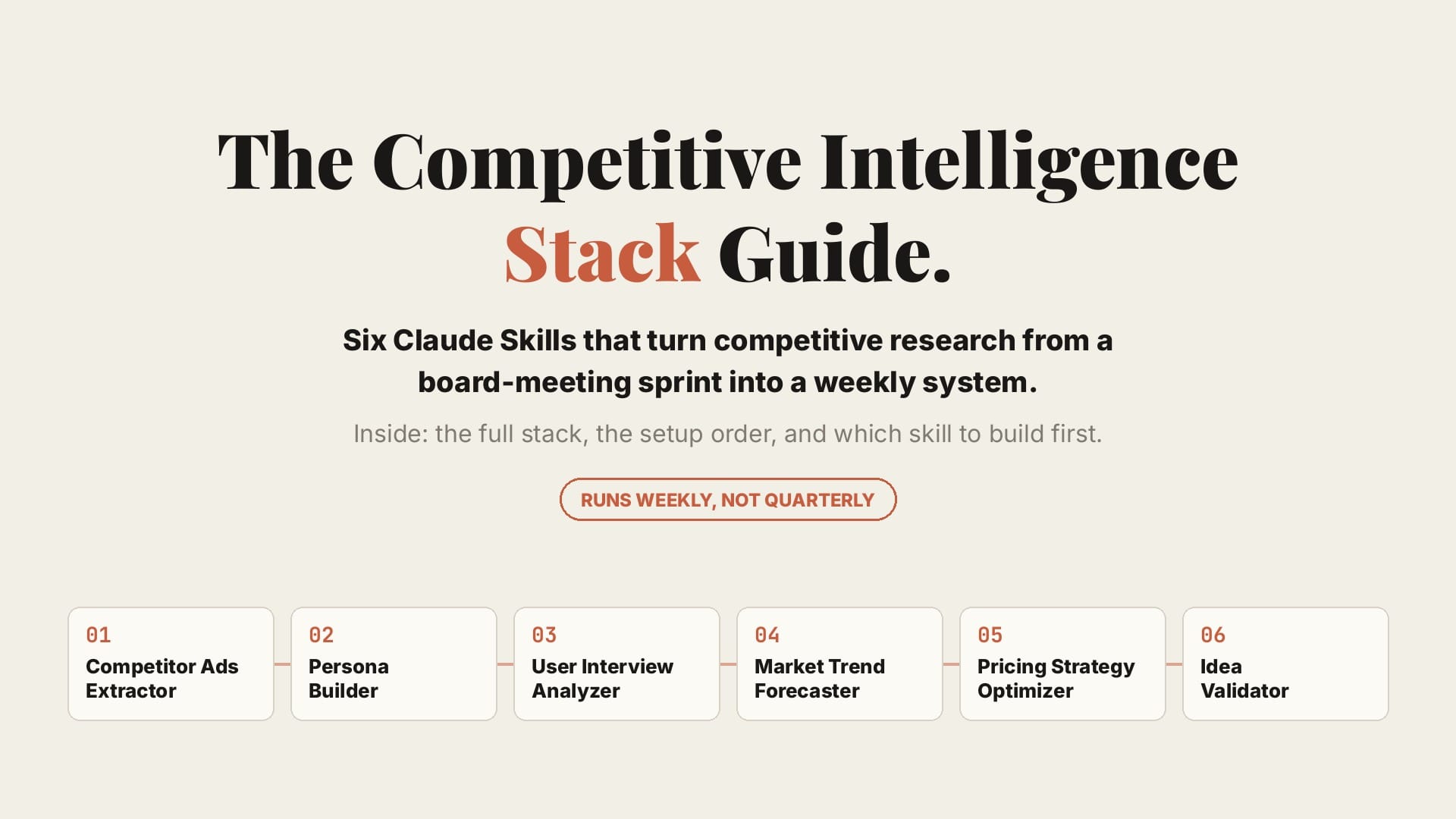
Competitive intelligence for marketers is the process of tracking competitor advertising, messaging, pricing, and positioning to inform campaign decisions. Most teams run it 2-4 times a year, usually in response to a board meeting. A weekly cadence, run through a repeatable AI workflow, tends to catch shifts before they become category-wide.
Key Takeaways
- Most marketing teams run competitive research 2-4 times per year, usually in a rush before a board meeting
- A six-skill Claude AI stack covers the full competitive research cycle in one sitting - no research team, no expensive subscriptions
- The stack covers: ad creative analysis, customer persona research, user interview synthesis, market trend monitoring, pricing strategy, and idea validation
- Weekly cadence surfaces patterns that quarterly research misses
- Each skill produces a standalone, shareable output - a teardown, a brief, a scorecard
Why Do Most Marketing Teams Only Do Competitive Research Once or Twice a Year?
Most competitive intelligence for marketers follows a familiar pattern. Someone panics the week before a review. They export a competitor's pricing page, screenshot a few ads, and skim a G2 review thread. That becomes "the competitive research."
It's not that the research is wrong. It's that it only happens when there's urgency - which means it's already catching up to what's happening, not getting ahead of it.
Something I've been noticing after running competitive research on a weekly cadence for a few months: the teams that do it regularly spot things earlier. They react to category shifts before competitors have already scaled the response. They build positioning from a current picture of the market, not a six-month-old one.
The thing that changed for me wasn't budget or headcount. It was switching from ad-hoc research to a repeatable six-skill stack.
What Is Competitive Intelligence for Marketers?
Competitive intelligence for marketers is the systematic process of gathering, analyzing, and acting on information about competitors - including their advertising strategies, customer messaging, pricing models, and market positioning.
Traditional competitive intelligence required either a dedicated research team or subscriptions to specialized tools like Crayon, Klue, or Semrush Trends. Large language model (LLM)-based tools have changed what's accessible for solo marketers and small teams without those resources.
A complete competitive intelligence process for marketers typically covers five layers:
- Ad creative analysis - what competitors are saying to acquire customers, and what formats they're betting on
- Customer persona research - who competitors are targeting and what language those customers use
- Market trend monitoring - what is shifting at the category level, not just the competitor level
- Pricing strategy analysis - how competitors frame and position value, not just what they charge
- Idea validation - whether a new campaign or product direction holds up against market reality before you spend on it
The six-skill stack below covers all five layers.
The 6-Skill Competitive Intelligence Stack
The stack is built on Claude Skills - reusable AI workflows that run inside Claude and each produce a structured, shareable output.
| Skill | What It Analyzes | Output |
|---|---|---|
| Competitor Ads Extractor | Ad library data, messaging patterns | Creative teardown |
| Customer Research + Persona Builder | Interview notes, reviews, survey data | 8-component buyer persona |
| User Interview Analyzer | Raw interview transcripts | Pain-point map with verbatim quotes |
| Market Trend Forecaster | Industry signals, news, product launches | Quarterly threat-and-opportunity brief |
| Pricing Strategy Optimizer | Competitor pricing + behavioral psychology | Recommendation memo |
| Idea Validator | Market reality vs. campaign concept | Go/no-go scorecard |
Each Skill, Explained
1. Competitor Ads Extractor
What it does: Analyzes competitor ads from ad library data - Meta Ad Library, LinkedIn Campaign Manager exports, Google Ads Transparency Center - and maps messaging patterns across the full set.
Output: A creative teardown structured enough to hand directly to a designer or copywriter.
The teardown extracts: opening hooks, core value propositions, call-to-action patterns, creative formats, and audience signals. It maps these into a structured brief rather than a raw list of observations.
A pattern I keep seeing: teams that start with this skill tend to stick with the full stack. The output makes the case for the rest of the setup time.
Ad spend is a signal. What a competitor is willing to put money behind tells you what's working in the market. The Competitor Ads Extractor makes that signal readable.
2. Customer Research + Persona Builder
What it does: Synthesizes customer interview notes, product reviews (G2, Capterra, Trustpilot, App Store), and survey responses into structured buyer personas.
Output: An 8-component buyer persona built from what customers actually said - not what the marketing team assumed.
The 8 components: demographic context, primary job-to-be-done, key pain points, decision triggers, language patterns, top objections, preferred channels, and success metrics.
The key difference from a manual persona process: the skill surfaces the language customers use, which is often different from the language the brand uses. That gap is where messaging tends to break down.
3. User Interview Analyzer
What it does: Extracts themes, friction points, and unmet needs from raw interview transcripts. Works with a single transcript or a batch.
Output: A pain-point map with verbatim quotes, organized by theme and frequency.
The distinction from the Persona Builder: the Persona Builder synthesizes across multiple source types into a profile. The Interview Analyzer goes deeper into a single set of transcripts and preserves the original language.
Marketing teams often interpret rather than quote. A brief that says "customers feel overwhelmed by onboarding" is useful. A brief that includes the actual sentence a customer said is more useful. This skill keeps verbatim language front and center.
4. Market Trend Forecaster
What it does: Processes industry signals - news coverage, analyst reports, product launch patterns, regulatory shifts - and flags what's worth watching versus what's noise.
Output: A quarterly threat-and-opportunity brief, formatted for a leadership meeting.
This is the skill most teams skip when they're doing research reactively. When competitive research only happens in a crisis, trends are already priced in by the time you catch them.
Running it quarterly at minimum keeps you oriented to category-level shifts, not just competitor-level moves. The brief format means it's immediately shareable - no reformatting required before it goes to a founder or CMO.
5. Pricing Strategy Optimizer
What it does: Analyzes competitor pricing with behavioral economics frameworks applied - not just a comparison table.
Output: A recommendation memo with a specific pricing direction, not just a feature-by-price matrix.
Most competitive pricing research produces a comparison table. This skill goes further. It applies frameworks from behavioral economics - anchoring, decoy pricing, price sensitivity by segment, good/better/best structuring - to produce an actual recommendation tied to your positioning.
Input: competitor pricing pages, your current pricing, and any available conversion or churn data.
6. Idea Validator
What it does: Stress-tests a campaign or product concept against what's real in the market before you spend time or budget on it.
Output: A go/no-go scorecard across three dimensions: Desirability (does the market want this?), Feasibility (can we actually deliver it?), and Viability (does it make business sense?).
Something I've been testing with this one: using it before writing a campaign brief rather than after. The output changes what goes into the brief. That tends to reduce revision cycles later.
The validator works best when you run it on a specific, concrete idea - not a broad direction. "A campaign that positions us as the affordable option for mid-market SaaS teams" is a good input. "Something around pricing" is not.
How the Stack Works Together
The six skills are most useful when they feed into each other.
The Competitor Ads Extractor surfaces what competitors are claiming. The Customer Research + Persona Builder surfaces what customers actually want. The gap between those two is positioning opportunity.
The Market Trend Forecaster provides context for whether that positioning opportunity is growing or shrinking. The Pricing Strategy Optimizer shapes how you frame the offer. The Idea Validator checks whether a specific execution of that framing is viable before you build it.
A pattern I keep seeing: the teams that run the full stack weekly start to make different decisions about which campaigns to prioritize. Not because they have more data - but because they have a more current picture of the market than they did before.
The stack takes one sitting to run. No research team. No subscription to a dedicated competitive intelligence platform.
Frequently Asked Questions
What is competitive intelligence for marketers, and why does it matter?
Competitive intelligence for marketers is the ongoing process of tracking competitor strategies - advertising, messaging, pricing, and positioning - to inform decisions about your own campaigns and offers. It matters because markets shift faster than annual or quarterly research cycles can capture. Teams that monitor competitors regularly tend to react to changes before those changes become category-wide.
What is the best competitive intelligence tool for small marketing teams?
For small teams without a dedicated research function, the most practical approach is a structured AI workflow using Claude Skills. The six-skill Competitive Intelligence Stack described here covers ads, personas, interview analysis, market trends, pricing, and idea validation without requiring third-party data subscriptions or a research analyst.
How often should marketers run competitive research?
Most practitioners recommend monthly at minimum. Weekly is more useful for fast-moving categories. Quarterly provides category-level context but misses tactical shifts. A practical cadence for most teams: weekly lightweight research using a repeatable AI stack, plus a quarterly deep-dive for category-level analysis.
A few things a weekly cadence tends to surface that quarterly research misses: what competitors are testing versus what they're scaling, shifts in messaging before they show up in pricing or product announcements, and when a competitor goes quiet - often a signal of a pivot, a product problem, or a team change.
Can a solo marketer run competitive intelligence without a research team?
Yes. AI tools like Claude Skills make it possible for a solo marketer to run structured competitive research on a regular cadence. The key shift is moving from manual, ad-hoc research to structured workflows that produce usable, shareable outputs each time they run.
What does a competitive intelligence stack typically include?
A complete competitive intelligence stack for marketers covers: ad creative analysis, customer messaging research, interview synthesis, market trend monitoring, pricing analysis, and idea or campaign validation. Each layer answers a different strategic question. The six skills in this stack map directly to those six layers.
Download the Full Stack (Free)
The six skills described in this post are available as a free download. Each is a Claude Skill file (.skill format) you can install directly into Claude.
What's included:
- Competitor Ads Extractor
- Customer Research + Persona Builder
- User Interview Analyzer
- Market Trend Forecaster
- Pricing Strategy Optimizer
- Idea Validator
Download the Competitive Intelligence Stack - Free
Setup order that tends to work: Start with the Competitor Ads Extractor. Run it once on a real competitor. See what the output looks like. Then decide which skill to add next based on where you have the biggest gap.
Most people move to the Customer Research + Persona Builder second - because the Ads Extractor surfaces what competitors claim, and the Persona Builder surfaces what customers want, and the gap between those two is usually where the next campaign comes from.
Summary
Competitive intelligence for marketers works best as a regular practice, not a once-a-year project. The six-skill stack described here covers the full research cycle - ads, personas, interviews, trends, pricing, and validation - in one sitting.
The tools are downloadable. The setup takes a few minutes per skill. And the cadence - weekly research instead of quarterly - is where most of the value comes from.
Curious whether others have tried running competitive research on a regular schedule, or whether it's still a board-meeting sprint in most places. Happy to hear what's working.
Rananjay Raj writes about AI-driven marketing workflows at BuildWire AI. Connect on LinkedIn: @rananjayraj.