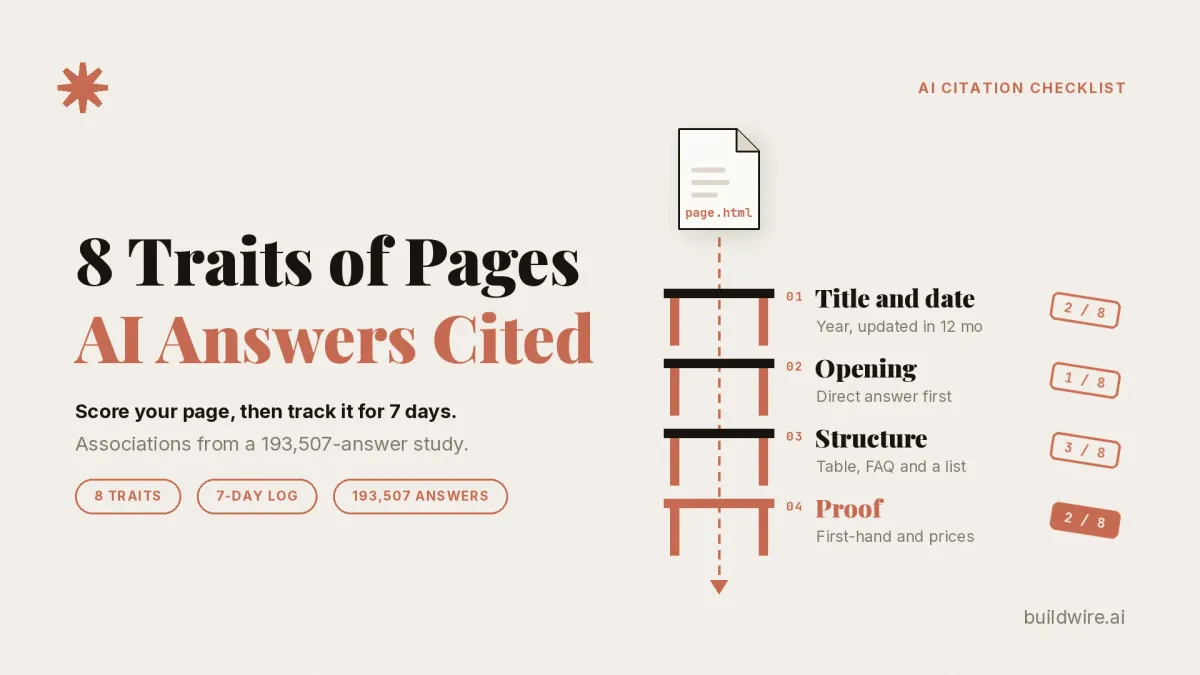
This takes ten minutes to check and one week to log.
Score your page against the 8 traits that were more common on pages AI answers cited in a 193,507-answer study. Then log whether your page is cited on each of 7 days. These traits are associations from one agency's client data, not causes. Use the score to pick what to check, and use the log to see what happened over a week.
Passed-over page is Robertson's term for a page in Google's top 10 for the question that the AI never cited. Source: 2026 AI Citation Study
Higher odds is how Robertson reports each trait. Pages with the trait are compared against similar pages without it. So "69% higher odds" for tables describes that comparison. It does not mean a 69% chance of being cited. Source: 2026 AI Citation Study
Days cited out of 7 is the weekly metric Anymorph recommends. For each key query and engine, count the days in a week your page was cited. Source: How Long Do AI Search Citations Last?
At a glance, you'll build:
- An 8-trait page score
- A baseline log
- A 7-day tracking sheet
- A before and after comparison
What did the 193,507-answer study compare?
TJ Robertson of TJ Digital published the 2026 AI Citation Study on 25 Oct 2026. It covers 193,507 answers from three engines. ChatGPT gave 67,543, Google AI Mode gave 63,033 and Google AI Overviews gave 62,931.
The answers were collected weekly from 27 Aug to 21 Oct 2026. They came from 4,167 buyer questions that do not name a brand. The questions belong to the 78 client businesses TJ Digital tracks in Peec AI.
The study compares two groups of pages. Cited pages appeared in the AI answers. Passed-over pages ranked in Google's top 10 for the same question but never appeared in the AI's searches.
The trait comparison used 21,874 cited pages and 4,507 passed-over pages across 434 questions. It accounts for each site's Ahrefs Domain Rating and for page type. Each result is given as higher or lower odds of being cited.
Robertson lists the limits himself:
- "These are associations." The study shows which traits cited pages have, and it can't prove any trait causes a citation.
- The sample is TJ Digital's own client businesses.
- Keywords stand in for questions, and the Google data is one snapshot.
Robertson also reports that tables mattered even more in ChatGPT, where pages with a table had 88% higher odds.
Which 8 traits were more common on cited pages?
Here are the eight traits we chose, with the study's figures from the 2026 AI Citation Study.
| Trait | What the study found | Check on your page |
|---|---|---|
| Year in the title | More than twice the odds | Does the title show the current year, and is the content current for that year? |
| Updated in the past 12 months | 88% higher odds for pages published or updated in the past 12 months | Is there a real publish or update date within the past 12 months? |
| A table | 69% higher odds | Does the page compare options, prices or numbers in a table? |
| First-hand experience | 45% higher odds | Does the page show something your team did, tested or saw? |
| Prices shown | 28% higher odds | If the topic has a price, does the page state it? |
| An FAQ | 26% higher odds | Is there an FAQ section with questions buyers ask? |
| A list | 22% higher odds | Is there a list of steps, options or criteria? |
| A direct answer in the opening lines | Cited pages opened with a direct answer 20% of the time, passed-over pages 5%, judged by blind AI raters over 195 pairs | Do the first lines answer the main question in plain words? |
The direct answer row uses a different measure from the others. It comes from blind ratings of 195 page pairs, not from the odds comparison.
The study did not support every common tip. Pages with an author byline had 28% lower odds, and pages with a call to action had 12% lower odds. Robertson writes: "I can't tell you why the byline and call-to-action results came out that way. Because they're associations, I wouldn't remove either from your pages based on this alone." Schema markup was a little more common, at 13% higher odds. He would not put schema work ahead of the content.
We picked these 8 because a person can check them on one page in ten minutes. The study covers more traits.
What do people search for around AI citations?
We analyzed 10 search terms and the top Google results for "how to get cited by chatgpt" with DataForSEO on 29 Oct 2026. Volumes are monthly US searches. Difficulty runs from 0 to 100.
| Search term | Monthly US searches | Difficulty |
|---|---|---|
| chatgpt citations | 720 | 11 |
| ai citations | 720 | 43 |
| how to get cited by chatgpt | 170 | 9 |
| how to rank in chatgpt | 140 | 1 |
| ai overview optimization | 90 | 32 |
| geo checklist | 40 | 0 |
| aeo checklist | 40 | 0 |
| generative engine optimization checklist | 40 | 22 |
| ai seo checklist | 20 | Not returned |
| get cited by ai | 10 | Not returned |
The two biggest terms mean something else. For "chatgpt citations" and "ai citations", the top results are library and style guides. They explain how to cite ChatGPT or AI in APA and MLA. So much of that volume is likely about citing AI in a paper. We cannot split it by intent.
The intent changes for "how to get cited by chatgpt". The eight organic results are marketing guides, for example kime.ai, alhena.ai, purposelaunch.com and genengineoptimizers.com. A YouTube Short and a LinkedIn article also appear. Google's AI Overview lists Search Engine Land, YouTube and Medium as sources. None of the result titles names a measured study or offers a per-page score with a tracking sheet.
Those guides give advice. We found none whose title offers a score for one page plus a way to log whether it is cited.
How do you score a page on the 8 traits?
This score works on one page at a time. For a brand-level baseline across many questions, use our 7-step AEO audit.
- Pick one page and write down the main question it answers.
- Answer yes, no or not relevant for each trait. Use the checks in the trait table.
- Score the yes answers out of the traits that apply. A page with 5 yes answers from 7 relevant traits scores 5 of 7.
- Write the date and the score in your log before you change anything.
- Change the page only where a check fails and the change is true. For example, mark a page as updated only if you updated it.
Copy this score card for each page.
| Trait | Yes, no or n/a |
|---|---|
| Year in the title | |
| Updated in the past 12 months | |
| A table | |
| First-hand experience | |
| Prices shown | |
| An FAQ | |
| A list | |
| A direct answer in the opening lines |
The score tells you which traits your page lacks. It says nothing about whether the page will be cited. That is the job of the tracking sheet.
Why track a page for 7 days instead of checking once?
Citations move a lot from one check to the next. Two separate studies show this, and they measure it in different ways.
In the 2026 AI Citation Study, Robertson asked the same engine the same question a week later. Only 24 to 28% of cited pages were cited again. That range runs from the lowest to the highest of the three engines. When he asked the same question twice on the same day, 23 to 25% of the cited pages matched.
Anymorph measured something else. Its citation persistence research by Junhyeok Song covers 324,215 answers from ChatGPT, Gemini, Google AI Overviews and Naver AI Tab. The data ran from 16 to 23 Oct 2026 across 32 measurement projects. Each query was asked once per engine per day.
In English, next-day page retention was 25.3% in ChatGPT, 30.6% in Gemini and 17.2% in Google AI Overviews. Across a week of English data, 66.5 to 73.9% of cited pages, depending on the engine, were cited on only one of the 7 days.
Anymorph puts it plainly: "If you judge a page's performance solely by whether it was cited or not on any one day, you will mostly be seeing chance variation."
Robertson compares the same engine a week later. Anymorph compares the next day. The numbers sit side by side here, and we do not combine them.
How do you run the 7-day tracking sheet?
The sheet is free. Download the 7-day tracking sheet (CSV)
To score each page on the 8 traits, Download the 8-trait page score (CSV) and use one row per page. To see the 7-day tracker filled in, Download the example data (CSV); every number in it is example data, not real results.
| Column | What to enter |
|---|---|
| Query | The question you ask the engine |
| Engine | ChatGPT, Google AI Mode or Google AI Overviews |
| Your page URL | The page you scored |
| Day 1 to Day 7 | 1 if your page is cited in that day's answer, 0 if not |
| Days cited out of 7 | The sum of the seven day columns |
| Notes | Any change you made to the page, with the date |
Use one row per query and engine. Robertson found the engines rarely cite the same pages. AI Mode and AI Overviews shared 12% of their cited pages. ChatGPT shared about 5% with either.
- Pick 5 to 10 queries a buyer would ask without naming a brand.
- Ask each query in each engine at about the same time each day for 7 days.
- Record 1 or 0 in that day's column.
- Add the day columns to get days cited out of 7.
- If you change the page, log the change in Notes. Then track the 7 days after the change and compare periods of the same length.
Here is a worked example. Example data, not a result.
| Query | Engine | Your page URL | D1 | D2 | D3 | D4 | D5 | D6 | D7 | Days cited out of 7 |
|---|---|---|---|---|---|---|---|---|---|---|
| Example query A | ChatGPT | /example-page/ | 1 | 0 | 0 | 1 | 0 | 0 | 0 | 2 |
| Example query A | Google AI Mode | /example-page/ | 0 | 0 | 1 | 0 | 0 | 0 | 0 | 1 |
| Example query B | Google AI Overviews | /example-page/ | 1 | 1 | 0 | 1 | 0 | 1 | 1 | 5 |
In this example data, the page scores 2, 1 and 5 days out of 7. Each row is its own engine and query, so we read each row on its own.
If you prefer software for the daily checks, our guide to AI visibility trackers by job compares the options. Citations are a different number from visits. To count visits from AI answers, use our GA4 AI traffic guide. Google's own numbers live in the Search Console AI Overviews report. For a weekly review of the answer at the top of each page, see our answer-block review loop.
What should you not read into this checklist?
- Do not treat the 8 traits as causes. The study shows which traits cited pages had more often.
- Do not add a year or a date to a page without a real update.
- Do not drop a byline or a call to action because of one study.
- Do not read one day's answer as a ranking.
- Do not add the two studies' retention numbers together. They measure different time gaps.
The short version
- Pick one page and the main question it answers.
- Score it yes, no or n/a on the 8 traits that were more common on cited pages.
- Write the date and score in the log before you change anything.
- Track 5 to 10 queries in each engine for 7 days, one row per query and engine.
- If you change a page, log the change and track the next 7 days.
- Compare days cited out of 7 for same-length periods, and treat every gap as an association.
If you want help running this score and log on your own site, see our AEO and SEO services.
Book a call: 30 minutes with Rananjay to set this up for your site.
Want the AI visibility workflows we run every week, written up like this one? Subscribe to The AI Driven Marketer newsletter, and follow along as we turn slow marketing jobs into short ones.
FAQ
What is an AI citation study?
An AI citation study collects answers from AI engines and records which pages they cite. It then compares cited pages with other pages to see which traits were more common. The 2026 AI Citation Study did this with 193,507 answers from ChatGPT, Google AI Mode and Google AI Overviews.
How do you get cited by ChatGPT?
Nobody can promise a citation from ChatGPT. In this study, cited pages more often showed eight traits. These were a year in the title, a recent update, a table, first-hand experience, prices, an FAQ, a list and a direct answer. You can check your page for these traits and log what happens over 7 days.
Does putting the year in the title get a page cited?
The study cannot show that. It shows an association. Pages with a year in the title had more than twice the odds of being cited compared with similar pages without one. Add a year only when the content is current for that year.
How long should you track a page?
Use a 7-day window. Anymorph found that, depending on the engine, 66.5 to 73.9% of English pages cited over a week appeared on only one day. It recommends counting the days cited out of 7 for each key query and engine.
Do the same pages get cited in ChatGPT, AI Mode and AI Overviews?
Rarely. Robertson found that AI Mode and AI Overviews shared 12% of their cited pages. ChatGPT shared about 5% with either. That is why the tracking sheet uses one row per query and engine.
Is this study a reason to rewrite every page?
No. It is one agency's client data, covering 78 businesses, and it shows associations. Use the score to find gaps on pages that matter to you. Make only true changes, log them and compare same-length periods.
How we checked this guide
On 29 Oct 2026 we read Robertson's 2026 AI Citation Study (25 Oct 2026) and Anymorph's citation persistence research (27 Oct 2026) in full. The keyword and SERP data come from one DataForSEO pull, US, 29 Oct 2026. Robertson's study covers the author's own 78 client businesses and shows associations, not causes.
The 8 traits and the tracking sheet are BuildWire's own framework, built on top of those two studies. Learn more about BuildWire.
Editorial note: every figure in this guide links to its source. To report an error, use our contact page.