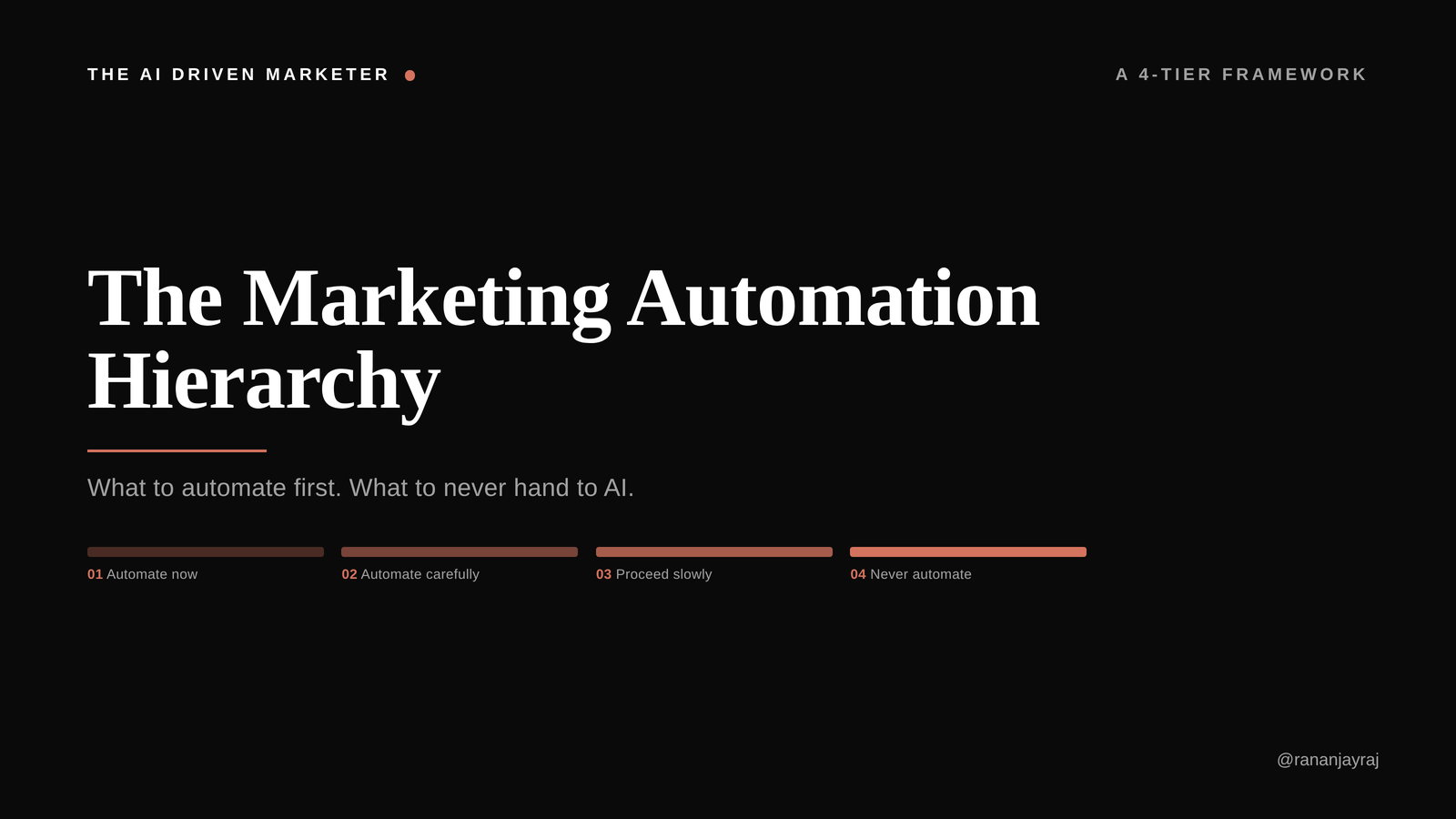
What to automate first, what to automate carefully, and what to never hand to AI.
What is the Marketing Automation Hierarchy?
The Marketing Automation Hierarchy is a 4-tier framework for deciding which marketing tasks to hand to AI and which to keep human. It sorts work by two things: how much judgment a task needs, and whether it builds a relationship. The less judgment a task needs and the fewer relationships it touches, the safer it is to automate.
The hierarchy at a glance:
Tier | Rule | Return | Risk |
|---|---|---|---|
Tier 1 | Automate now | ~800-1000% | Near zero |
Tier 2 | Automate carefully | ~300-500% | Medium |
Tier 3 | Proceed slowly | Low | High |
Tier 4 | Never automate | Negative | Severe |
How do you decide what to automate?
Run any task through three questions:
- Is it repetitive? Yes points toward automation. No keeps it manual.
- Does it need real judgment? Low judgment is a candidate. High judgment stays human-led.
- Does it build a relationship? If yes, never automate it.
The shortcut: repetitive + low judgment + no relationship = automate it. Anything that touches a relationship stays human.
Tier 1
What should you automate first?
Start with work that is repetitive, low-judgment, and relationship-free. It carries the highest return and almost no risk.
- Reporting and dashboards. Pull GA4, LinkedIn, and ad-platform numbers into one weekly summary. From 5-10 hours a week to about 10 minutes.
Tools: GA4 + n8n or Make + Claude or Gemini for the written summary - Competitor monitoring. Track rival site, ad, and pricing changes and get a daily digest. From 3-5 hours a week to a daily auto digest.
Tools: a change tracker + Gemini or Claude to summarize - Performance anomaly alerts. Catch a broken funnel within 24 hours instead of noticing it 2-4 weeks later.
Tools: GA4 alerts + n8n + an LLM to explain the drop - Research synthesis. Turn interview notes, survey responses, and feedback into themes. From 6-8 hours per analysis to about 30 minutes.
Tools: a transcription tool + Claude for long-context synthesis - Content repurposing. Turn one LinkedIn post into an X thread, a newsletter section, and a YouTube outline. From 2-3 hours per piece to about 15 minutes.
Tools: Claude or Gemini + a scheduler
Return ~800-1000%. Risk near zero. Start here and master it before moving on.
Tier 2
What should you automate carefully?
Work where AI gives you a strong head start but a human still owns the result. Good return, as long as you watch the quality.
- First drafts. Claude gets closest to your own voice from a few writing samples. Still edit before publishing. Saves 40-60% of writing time.
- SEO and AEO drafts. Claude writes the natural, citable prose answer engines favor. You lock the technical structure: meta tags, schema, internal links.
- Campaign ideas. Generate concepts to filter, not finished campaigns. The strategic call is yours.
- Lead scoring. An initial pass that a human verifies before any outreach.
Tools: your CRM + an LLM - Basic design. Social graphics, thumbnails, and mockups for fast iteration. Final polish stays manual.
Tools: Canva AI, Gemini, or GPT Image
Return ~300-500%. Risk medium. Automate with a human checkpoint.
Tier 3
What should you slow down on?
Work where AI can assist your thinking but must not make the call. Low return, high risk if you let it run.
- Client communication. Draft only, then personalize heavily. Obvious automation breaks trust fast.
- Strategic planning. AI gives inputs and analysis. The decision stays human. Auto-planning produces generic strategy.
- Creative direction. Use it to explore options. Authentic creative still needs a human to choose and shape it.
Use AI for inputs. You make the decision.
Tier 4
What should you never automate?
Work that depends on empathy, judgment, and a point of view that is uniquely yours. Automate it and you destroy the value.
- Relationship building. DMs, networking, partnerships. Automated outreach reads as spam and erodes your brand.
- Crisis response. It needs empathy and judgment. AI cannot read the room, and one bad auto-reply does real damage.
- High-stakes negotiation. Nuance and reading between the lines decide the outcome. Automation leaves money on the table.
- Brand voice. Your point of view is what makes you worth following. Automate it and you sound like everyone else.
Your authenticity is the moat. Automation should protect it, not replace it.
Worked examples
"Should I automate LinkedIn DMs?" Repetitive yes. Needs judgment yes. Builds a relationship yes. Verdict: no, keep it manual.
"Should I automate data reporting?" Repetitive yes. Needs judgment no. Builds a relationship no. Verdict: yes, automate it now.
"Should I automate content drafts?" Repetitive yes. Needs judgment medium. Builds a relationship no. Verdict: strategically, first draft only.
FAQ
What is the Marketing Automation Hierarchy?
A 4-tier framework for deciding which marketing tasks to hand to AI and which to keep human: automate now, automate carefully, proceed slowly, and never automate.
What marketing tasks should you automate first?
Reporting, competitor monitoring, performance anomaly alerts, research synthesis, and content repurposing. They are repetitive, low-judgment, and relationship-free, so they carry high return and near-zero risk.
What should you never automate in marketing?
Relationship building, crisis response, high-stakes negotiation, and your brand voice. These depend on empathy, judgment, and a point of view that is uniquely yours.
How do you decide whether to automate a marketing task?
Ask if it is repetitive, if it needs real judgment, and if it builds a relationship. Repetitive plus low judgment plus no relationship means automate it. Anything that touches a relationship stays human.
Is it safe to automate content writing for SEO and AEO?
Partly. Use AI for first drafts and natural, citable prose, where Claude tends to match your voice from samples. Keep the technical structure and the final edit human, because models often ignore strict formatting rules.
Which AI tools are best for marketing automation?
Match the tool to the task: GA4 with n8n or Make for data, Claude for voice-matched long-form, Gemini for real-time research, ChatGPT for structured short copy, and your CRM with an LLM for scoring. No single tool wins everywhere.
The ROI calculator: run your own numbers before you build
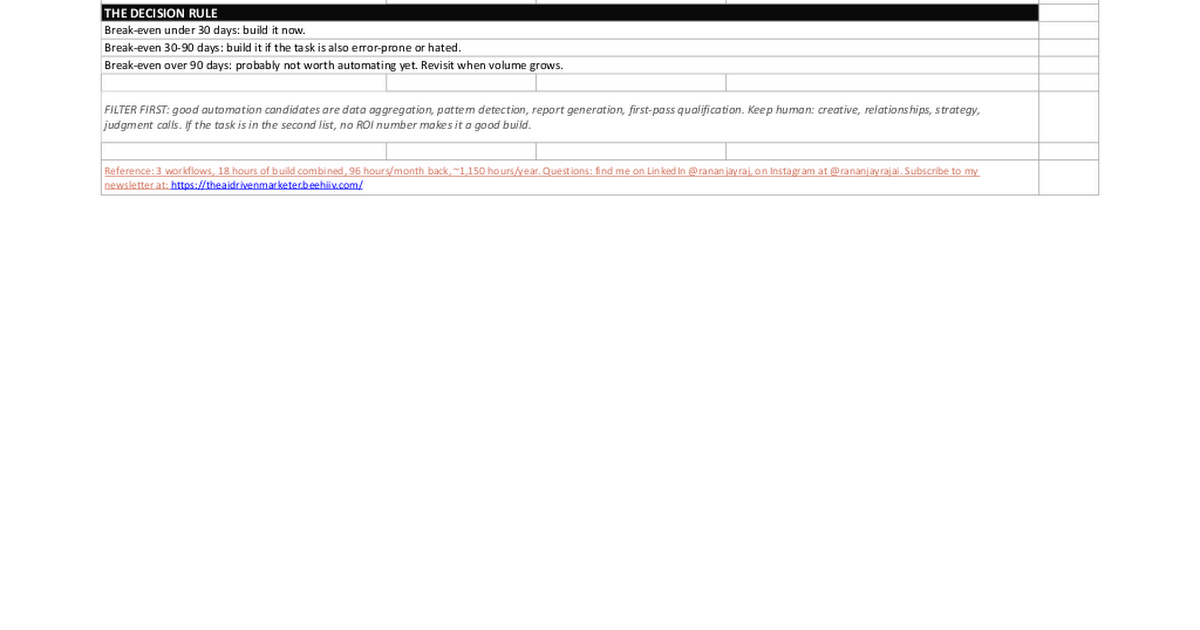
Every automation decision in this guide came out of one simple spreadsheet, and I've attached that ROI calculator here so you can run your own numbers in a few minutes.
It works in three parts:
- Part 1 prices your manual work today. Hours per week on the task, times your effective hourly value. That's the real cost of doing it by hand.
- Part 2 prices the build. Estimated build hours, plus any tool or API spend.
- Part 3 does the payback math for you. Hours saved per month, break-even in workdays, and the yearly value of the time you get back.
You only fill the orange cells. Five inputs, and everything else calculates on its own. A worked-example column shows my own competitive-intel numbers (8 hours a week replaced, a 6-hour build, break-even on workday 4), so you can check your figures against a real one.
One thing I learned running this a few times: be honest on the hours-per-week input. Most people undercount, because they forget the context-switching cost around a task, not just the task itself. If anything, round up.
Download the calculator below, run it on the one task that annoyed you most this week, and check the result against the 30-day rule. I keep noticing that most people have at least one under-30-day payback sitting in their weekly routine without realizing it.
Download

About the Author:
Rananjay is a marketing automation practitioner with 15+ years in enterprise marketing. He has built 90+ Claude Skills and writes about AI-driven marketing systems at @rananjayraj on LinkedIn.
LinkedIn | The AI Driven Marketer | Website | Github | Youtube